S.papillosum versus S.palustre from IFLI field day at West Moss, Fallin.
These are both big, blousy species in the section Sphagnum. The papillosum on the left here shows the stubby sausage branches, though I think it may not always be so simple
Showing posts with label #sphagnum. Show all posts
Tuesday, 20 September 2016
Friday, 20 May 2016
Learning to love the Sphagnales III - S.subnitens
Still trying to learn to love the Sphagnum. This one comes from the Isle of Mull and it has some signature features that ought to make it readily identifiable in the field ... maybe.
First up it's a bit dingy lookg - at least this one is. It isn't always, apparently. But the capitulum also has a tendency to a green centre with more red pigments around the outside. Like so:
Next it has a reddish stem, almost triangular upright stem leaves (but slightly more "square" proximally), and typically two branching stems and one trailing. Like so:
Seems like that's enough to be going on with. I kind of fell, sort of, that I would know it again if I were to come face to face with it. Though I probably will have forgotten its name by then!
First up it's a bit dingy lookg - at least this one is. It isn't always, apparently. But the capitulum also has a tendency to a green centre with more red pigments around the outside. Like so:
Next it has a reddish stem, almost triangular upright stem leaves (but slightly more "square" proximally), and typically two branching stems and one trailing. Like so:
Seems like that's enough to be going on with. I kind of fell, sort of, that I would know it again if I were to come face to face with it. Though I probably will have forgotten its name by then!
Monday, 9 November 2015
Learning to love the Sphagnales II - S.magellanicum
Another nice big fat species from the Sphagnum section of the genus, but this time with a fatter head and some nice colour
![]() |
| A dull brown with 3% KOH applied |
Thursday, 29 October 2015
Learning to love the Sphagnales
Three Sphagna from two sites and three sections gave an opportunity to get out the books and learn to love Sphagnum. Not quite there yet, but they are kind of attractive and they can't be that difficult, can they?
The BBS field guide operates on four groups, which Smith says there could be 11 and Frey says the molecular data supports not more than 4. In terms of field ID though as long as the groupings get you to a species I don't mind arguing about the rest later.
Now I've started to get a feel for them I'll have to seek out some more to play with
S.palustre - section Sphagnum
Hooded branch leaves get you into the section and it's a pretty closed group. It also has a fat stem cortex but you don't necessarily need to see that. S.palustre is a common one and a big blousy affair, with fat branches and of course hooded leaves. This one was picked up in woodland and with pretty catholic tastes this seems like the most likely one to find in that environment. The capiltula is darker than the surrounding branches.
S.capillifolium - section Acutifolia
This section has a rosy pin-red tint (pigment anthocyanin) which is detectable with alkaline. I applied some KOH to the leaves to get a blue reaction here. A slender species with a red stem, S.capillifolium also has the centre of the capitulum a deep red and deeper than its edges. A paler centre sends you in another direction.
S.denticulatum - section Subsecunda
This is the section of bendy branches, and in this case at least a bendy capitulum too. denticulatum is a common bog moss and likes ditches. Once you get into the section by the manifest bendiness of it all (English name "cow horn bog moss"!) this species is separated from its buddies by having particularly pointed (lanceolate) branch leaves.
References
Sphagnum: A Field Guide, Hill, M.O.
Mosses and Liverworts of Britain and Ireland: A Field Guide, Atherton,D.M & Bosanquet,S.D.S.
The Liverworts, Mosses and Ferns of Europe, Frey,W & Frahm,J-P (trans. T.Blockeel)
The Moss Flora of Britain and Ireland, Smith,A. J. E. & Smith,R
The BBS field guide operates on four groups, which Smith says there could be 11 and Frey says the molecular data supports not more than 4. In terms of field ID though as long as the groupings get you to a species I don't mind arguing about the rest later.
Now I've started to get a feel for them I'll have to seek out some more to play with
S.palustre - section Sphagnum
Hooded branch leaves get you into the section and it's a pretty closed group. It also has a fat stem cortex but you don't necessarily need to see that. S.palustre is a common one and a big blousy affair, with fat branches and of course hooded leaves. This one was picked up in woodland and with pretty catholic tastes this seems like the most likely one to find in that environment. The capiltula is darker than the surrounding branches.
S.capillifolium - section Acutifolia
This section has a rosy pin-red tint (pigment anthocyanin) which is detectable with alkaline. I applied some KOH to the leaves to get a blue reaction here. A slender species with a red stem, S.capillifolium also has the centre of the capitulum a deep red and deeper than its edges. A paler centre sends you in another direction.
S.denticulatum - section Subsecunda
This is the section of bendy branches, and in this case at least a bendy capitulum too. denticulatum is a common bog moss and likes ditches. Once you get into the section by the manifest bendiness of it all (English name "cow horn bog moss"!) this species is separated from its buddies by having particularly pointed (lanceolate) branch leaves.
References
Sphagnum: A Field Guide, Hill, M.O.
Mosses and Liverworts of Britain and Ireland: A Field Guide, Atherton,D.M & Bosanquet,S.D.S.
The Liverworts, Mosses and Ferns of Europe, Frey,W & Frahm,J-P (trans. T.Blockeel)
The Moss Flora of Britain and Ireland, Smith,A. J. E. & Smith,R
Wednesday, 16 April 2014
Monday, 31 March 2014
Cullaloe Hills, Saturday, March 30th
Extended my coverage of the hills a bit, and apparently re-covered a small area too.New area in red at the bottom of the picture
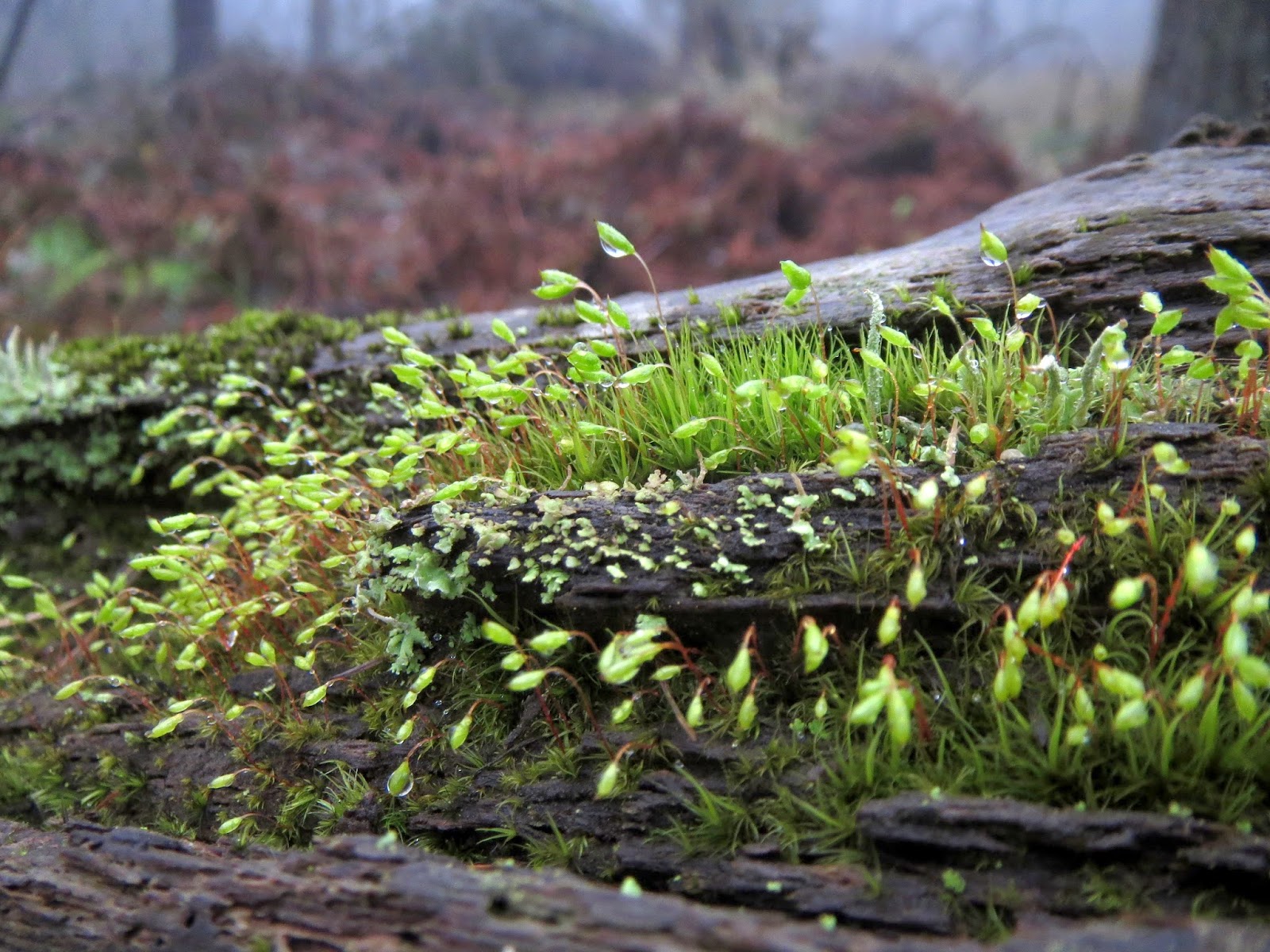
On a foggy morning in the mysterious looking forest I managed to find some Sphagnum at last, and only after some confusion realised I seem to have three species. I haven't managed to identify even one of them yet! I did find the already-mentioned Rhizomnium psuedopunctatum, and confirm Dicranum tauricum, both of which were good. I have a feeling a small bit of Calliergonella cuspidata is also new for me in the area.
Some scenes from the morning:
Having forgotten to take a pen, or even a hand-lens (in my other jacket!), I also took some small vouchers as an aide-memoire for some of the commoner species I recorded. Shows a nice variety of bryophyte forms.
And the three Sphagna
(I have a feeling the one on the left is S.squarrosum and the centre S.palustre)
On a foggy morning in the mysterious looking forest I managed to find some Sphagnum at last, and only after some confusion realised I seem to have three species. I haven't managed to identify even one of them yet! I did find the already-mentioned Rhizomnium psuedopunctatum, and confirm Dicranum tauricum, both of which were good. I have a feeling a small bit of Calliergonella cuspidata is also new for me in the area.
Some scenes from the morning:
Having forgotten to take a pen, or even a hand-lens (in my other jacket!), I also took some small vouchers as an aide-memoire for some of the commoner species I recorded. Shows a nice variety of bryophyte forms.
And the three Sphagna
(I have a feeling the one on the left is S.squarrosum and the centre S.palustre)
Subscribe to:
Posts (Atom)